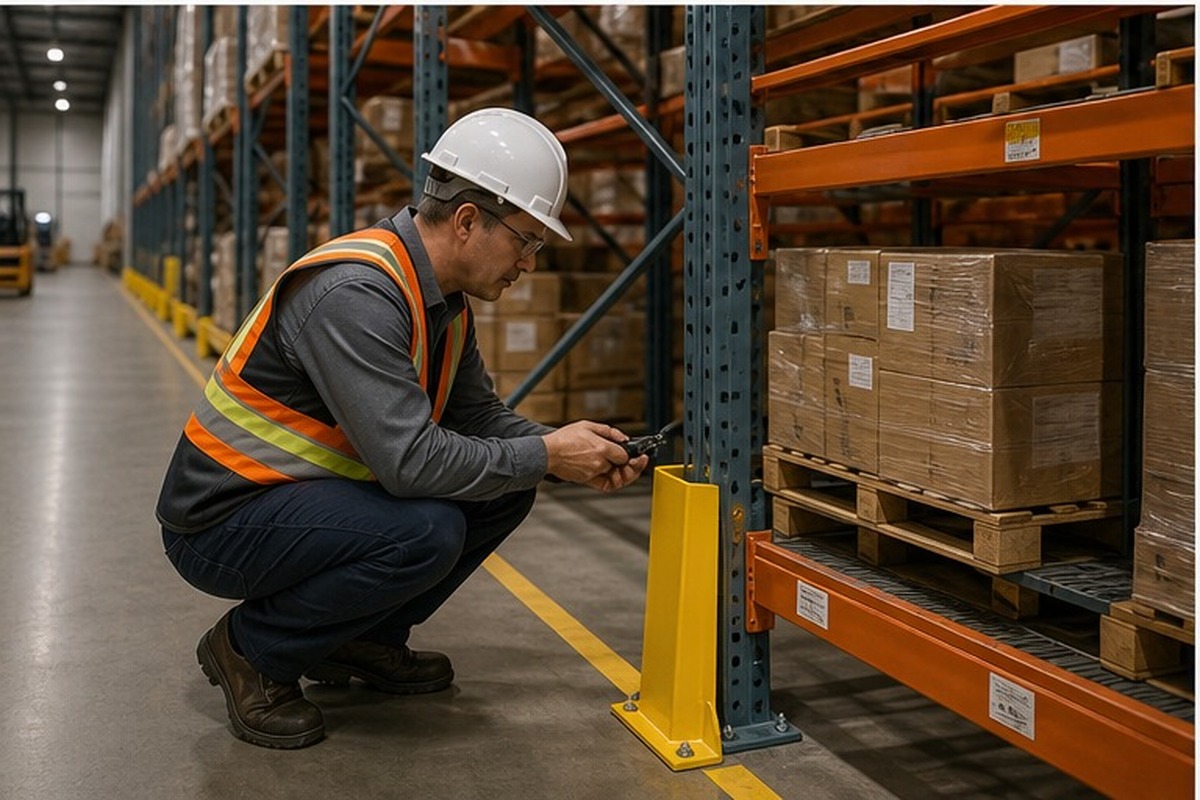
Pallet rack safety: Inspections, damage control, and load management
Rack safety is a management system: know what is installed, control how it is loaded and changed, detect damage early, and keep questionable conditions out of service until qualified review.
Rack-safety decisions depend on visible conditions, controlled access, documented escalation, and qualified review.
Warehouse Upgrade decision model
The rack-condition response path
Separate observation from engineering judgment so suspect conditions receive the right response.
01Observe
Record the location, component, visible condition, time, and supporting photos
02Control
Protect people and inventory; isolate questionable areas when required
03Review
Escalate to the manufacturer, engineer, or other qualified decision-maker
04Close
Correct, verify, authorize return to service, and preserve the record
Original Warehouse Upgrade planning diagram. Use verified facility inputs and qualified review where the decision requires it.
Quick answer
What you need to know
A pallet rack safety program combines verified system information, visible load controls, routine observations, documented inspections, immediate damage reporting, escalation rules, and qualified engineering or manufacturer review. It should also control configuration changes and preserve records so unresolved conditions cannot disappear between shifts.
Treat rack safety as a managed system
A rack is not just a collection of uprights and beams. Its performance depends on the installed configuration, anchors, connections, bracing, loads, pallets, lift-truck traffic, floor conditions, and changes made over time. A safety program has to manage those relationships rather than rely on an occasional walk-through.
OSHA requires stored materials to be stable and secure against sliding or collapse. Canadian guidance likewise emphasizes proper installation, maintenance, inspection, and reporting. Applicable building, fire, occupational safety, and rack-design requirements vary by location, so this guide is a planning framework rather than a compliance determination. The warehouse planning resources connect this safety framework with facility tools, checklists, project templates, and qualified specialist pathways.
Maintain a current inventory of rack areas, configurations, load signs, and responsible owners.
Give workers a simple way to report impacts and suspect conditions immediately.
Define who can isolate a bay, who evaluates damage, and who authorizes return to service.
Control beam moves, additions, repairs, and changes to pallets or products.
Use layers of inspection and escalation
Frequent operator observations, scheduled internal inspections, and periodic qualified reviews serve different purposes. Daily awareness may catch a fresh impact. A structured inspection finds patterns and documentation gaps. A qualified reviewer determines what a condition means for the system and what action is appropriate.
The rack inspection program guide explains how to assign frequencies and ownership. The inspection checklist turns that program into a repeatable field process without pretending that a checklist can make an engineering judgment.
Control loads, changes, and forklift interaction
Visible, configuration-specific load information helps operators keep loads within the system used for the rating. Missing or unclear signs should trigger document recovery and qualified verification, not a guessed capacity. Beam elevations, bay widths, anchors, components, or load characteristics should not be changed casually.
Vehicle contact is both an immediate condition and a process signal. Review the forklift impact guide for reporting and hotspot analysis, then use the load-sign guide to connect daily loading decisions with approved system information.
Close the loop with records and corrective action
A program is incomplete if it identifies conditions but does not track them to closure. Each record should identify the location, observation, date, reporter, interim control, reviewer, decision, responsible owner, and completion evidence. Preserve before-and-after photographs where useful and keep records accessible to the people managing the area.
Trend data can reveal repeated impacts at aisle ends, accumulating missing anchors, recurring load-sign gaps, or configuration changes that bypass review. Cross-link the findings with aisle-width planning and operations optimization so safety findings inform layout and flow decisions.
Manage pallet rack through its full facility lifecycle
Rack safety begins before installation and continues through use, inspection, change, repair, relocation, and decommissioning. Assign responsibilities and preserve system information at every stage.
Create a controlled rack information file
Maintain available drawings, permits, manufacturer information, approved load information, installation records, inspection history, repair documents, and configuration changes by area. Identify uncertainty rather than filling gaps with assumptions. Older or mixed systems may require a qualified survey before reliable operating information can be established.
Connect the records to a consistent aisle, row, bay, level, and component naming convention. Field signs, inspection records, work orders, photographs, and engineering decisions should all point to the same physical location and configuration.
System manufacturer and component identification where known
Approved configuration, drawings, and load information
Installation, alteration, relocation, repair, and permit records
Inspection findings, interim controls, decisions, and closure evidence
Current area owner and qualified-review contacts
Control installation, use, change, and end-of-life decisions
Procurement should define loads, pallet types, equipment, environment, building conditions, and required approvals before a system is selected. Installation and acceptance should follow the responsible design, manufacturer information, and applicable requirements.
During use, control beam moves, component substitutions, additions, repairs, load changes, relocation, and attachments. A change that appears minor can affect the configuration used for capacity or safety information. Decommissioned components should not return to service through an informal spare-parts pile.
Pallet rack lifecycle responsibilities
Lifecycle stage
Primary control
Required record
Escalation point
Design and procurement
Verified loads, facility conditions, and approved design
Basis of design and supplier documents
Unknown load, slab, fire, seismic, or code condition
Installation and acceptance
Approved components and configuration
Inspection, permit, and acceptance records
Field deviation or missing information
Operation
Load, pallet, equipment, and traffic rules
Training, load signs, and reports
Mismatch, impact, overload, or unstable load
Inspection and maintenance
Layered observation and documented response
Finding, control, disposition, and closure
Any condition requiring technical judgment
Change or repair
Authorized method and configuration review
Approval, work record, updated drawings and signs
Unapproved component or changed load path
Relocation or disposal
Controlled disassembly and suitability review
Inventory and disposition record
Unidentified, damaged, or mixed components
Define roles, training, and emergency response before an event
Workers should know what to observe, how to report it, how to protect the area, and which decisions they are not authorized to make. Technical disposition remains with the appropriate qualified authority.
Train each role for its actual decisions
Operators need impact reporting, load and pallet rules, signs, clearances, and stop-work expectations. Supervisors need location control, interim protection, notification, and record ownership. Internal inspectors need a defined visual scope and documentation method. Maintenance and contractors need change authorization and approved repair controls.
Training should use the site's actual naming convention, forms, contacts, and examples without encouraging unqualified structural classification. Refresh training after process, system, or responsibility changes and verify understanding through observation or exercises.
Who can stop or isolate work under the site procedure
How to report the exact location and preserve evidence
Who contacts qualified reviewers and controls the open item
Who authorizes repair, replacement, or return to service
How changes update records, load information, and training
Use a preplanned response path
The response should address people first, then area control, load condition, notification, documentation, qualified review, corrective action, and authorization to restore use. Emergency and imminent-hazard decisions must follow the facility's procedures and applicable requirements.
Run a tabletop exercise using a reported impact, missing load sign, unstable pallet, or discovered configuration mismatch. Confirm that after-hours contacts, barriers, alternate storage, and record systems are available when the normal program owner is absent.
Warehouse Upgrade modeled insight
Modeled workload for a quarterly rack sweep
20 bays/day
A facility with 1,200 bays that divides one full sweep across three months would plan 400 bays per month. At 20 inspection workdays per month, that is 20 bays per workday.
Assumptions
1,200 rack bays
One complete sweep per quarter
Three months per quarter
20 inspection workdays per month
Calculation
1,200 / 3 = 400 bays per month. 400 / 20 = 20 bays per workday.
How to use it: This is workload arithmetic, not a recommended inspection frequency or pace. Risk, local requirements, manufacturer guidance, system history, and qualified advice should determine the actual program.
Disclosure: This is an original planning model built from the stated assumptions. It is not an observed industry benchmark, safety finding, or guaranteed result. Replace the assumptions with verified facility data before making a decision.
Drill down
Specific decisions and operating problems
Use these focused guides when the broader framework is already clear and the team needs to resolve one specific comparison, calculation, or failure mode.
Field teams should be able to describe what they see, protect the area, and escalate it without guessing whether a damaged component is structurally acceptable.
Every reported impact needs a safe response, but repeated impacts also reveal where layout, visibility, traffic, training, or operating pressure deserves attention.
A layout audit compares the drawing, operating data, and observed floor so improvement priorities are based on repeatable evidence rather than anecdotes.
A rack price becomes a useful project budget only after configuration, loads, accessories, building interfaces, installation, phasing, and acceptance are defined.
Frequently asked questions
pallet rack safety FAQ
How often should pallet racks be inspected?
The frequency should reflect risk, traffic, impact history, manufacturer guidance, applicable requirements, and qualified advice. Many programs combine frequent observations with documented inspections and periodic qualified review.
Who can decide whether damaged rack is safe?
Workers can report and isolate suspect conditions, but a qualified person, engineer, manufacturer, or other authority appropriate to the jurisdiction and system should make technical disposition decisions.
Can damaged pallet rack be repaired in place?
Do not improvise repairs. Isolate the affected area and follow a documented repair or replacement method accepted by the appropriate qualified authority for the installed system.